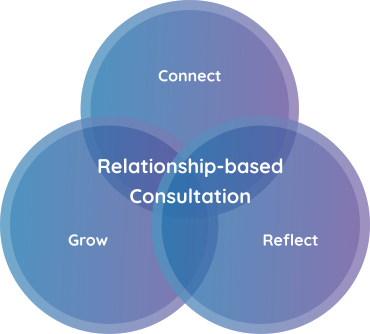
The IECMHC Network model reflects a relationship-based approach that emphasizes strengthening relationships among child care and early education providers and program leaders to build a solid foundation for working together. When child care and early education providers are supported with strategies, resources, reflective opportunities, and problem-solving support, they are better equipped to provide healthy learning environments for all children and families in their care. This model recognizes that the development of social and emotional skills occurs in the context of multiple interconnected, multi-generational relationships, both those between children and caregivers and between early childhood educators, program leaders and IECMH Consultants (Mondi, 2025).
Connect
The consultative stance model developed by Kadija Johnston and Charles Brinamen (2006) is one of the most commonly used approaches to incorporating the reflective practice into relationship-based consultation models. The model is comprised of ten elements to describe the consultant’s “way of being” in the consultative relationship. The IECMHC Network consultation model draws from the consultative stance by creating a space that offers early learning and care staff and providers reflective practice opportunities to thoughtfully consider their work and daily practices. In the context of this model, the IECMHC Network reflective consultation involves attending to the feelings and experiences of adults, as well as those of the children, given that learning and change take place within the context of these relationships.
Reflect
The consultant sees the early childhood educator and program leaders as the expert on their work. Sessions with a consultant supports the individual or team to slow down and think deeply about the successes and challenges that arise in the day-to-day connections with children and families. Although the activities of consultation vary, they typically include observations, conversations with staff that promote self-reflection, and discussions of children’s behavior in the context of development and culture (Schoch & Gal-Szabo, 2023).
Grow
In a partnership between the consultant and the early childhood educators, together they consider the meaning of young children’s behavior and how their own experiences and beliefs impact the way they respond to children. IECMH Consultants reflect with the staff about development of classroom and/or program management. Together they focus on relationship-building strategies to support more intentional and effective responses to behavior they find challenging and build their confidence working with children, families and staff.
How We Work
Classroom
Consultants offer consultation at the classroom level, working directly with the teacher(s) or home-based provider(s) to foster an environment that promotes children’s social and emotional health and well-being. Consultation enhances teachers’/providers’ abilities to address behavior they find challenging or concerning. Through reflective conversations with the consultant, teachers/providers consider the meaning of young children’s behavior and how their own experiences and beliefs impact the way they respond to children. Using a strength-based approach, consultants guide teachers/providers to develop classroom management and relationship-building strategies to improve their caregiving practices and build their confidence in working with all children and families.
Programmatic
Consultants offer consultation at the programmatic level to help foster a culture that promotes staff development and supportive relationships. Programmatic support includes collaboration with program leaders and staff to develop inclusive and equitable policies and procedures that reflect a commitment to serving all children and families. Consultation may involve training for staff and/or families on supporting children’s social, emotional, and behavioral health and fostering healthy relationships between young children and the adults who care for them.